
XCTU is a free multi-platform application designed to enable developers to interact with Digi RF modules through a simple-to-use graphical interface. It includes new tools that make it easy to set-up, configure and test XBee® RF modules. This section contains download and install instructions based on operating system. XCTU is compatible with Linux, OSX, and Windows. It may be necessary to configure your system prior to installing XCTU for the first time.
Do you have any thoughts on the best xbee modules to buy for development purposes? I am confused by the wide range of available options but my initial thinking was to buy two medium / high power with rpsma connections as this seemed to offer the best flexibility / price trade off ie: could be used to develop both short range and longer range projects. eg: http://www.sparkfun.com/commerce/product_info.php?products_id=8768.
Is there any reason to prefer Series 1 over series 2.5?
Thanks for the write-up.
X-CTU is the Windows software that is required to update the firmware of the XBee radios. It is not compatible with neither Linux nor Mac, but it can be used with wine - the Windows emulator.
I used Wineskin which produces standalone Mac Software packages based on wine.
 First of all, get the X-CTU program from digi.com, and get wineskin for Mac.
Follow the tutorial for software with a windows installer that comes with wineskin.
Just name your wrapper X-CTU and point to the X-CTU installer from digi.com in the steps where the tutorial uses Neverball.
After clicking the advanced tab of your new wrapper, in the tools section you click 'Test run application' to test your X-CTU program that you just wrapped for Mac.
You will see immediately that it complains that it cannot connect to com ports - as there are no com ports on the Mac.
Xbee X-ctu Software For Mac Download Windows 10
We have to map the USB ports to the com ports by hand:
The port mappings for your new wrapper live under Contents/Resources/dosdevices in the wrapper we just created and should have still opened in finder (at /Users/yourusername/Applications/Wineskin/X-CTU.app).
We now create softlinks from the mac USB ports to windows com ports. Plug in your device, open terminal and go to the dosdevices folder:
cd /Users/yourusername/Applications/Wineskin/X-CTU.app/Contents/Resources/dosdevices
Xbee X-ctu Software For Mac Downloads
Look up the device location of your plugged in device, it should be /dev/tty.usbserialXXXX for an XBee on a XBee explorer connected via USB. Here, XXXX is the device ID and is different for every device.
Choose a high number for the com port, as the lower ones may be already in use by wine. I have chosen 10.
ln -s /dev/tty.usbserialXXXX com10
Kill and test run your X-CTU wrapper application again, and the complaint about the missing com ports should be gone. Add your new com port now, so that X-CTU knows it:
In the bottom panel, go to the 'User Com Ports' tab. At the right, put your com port number in the box (e.g. 10) and press the 'Add' button.
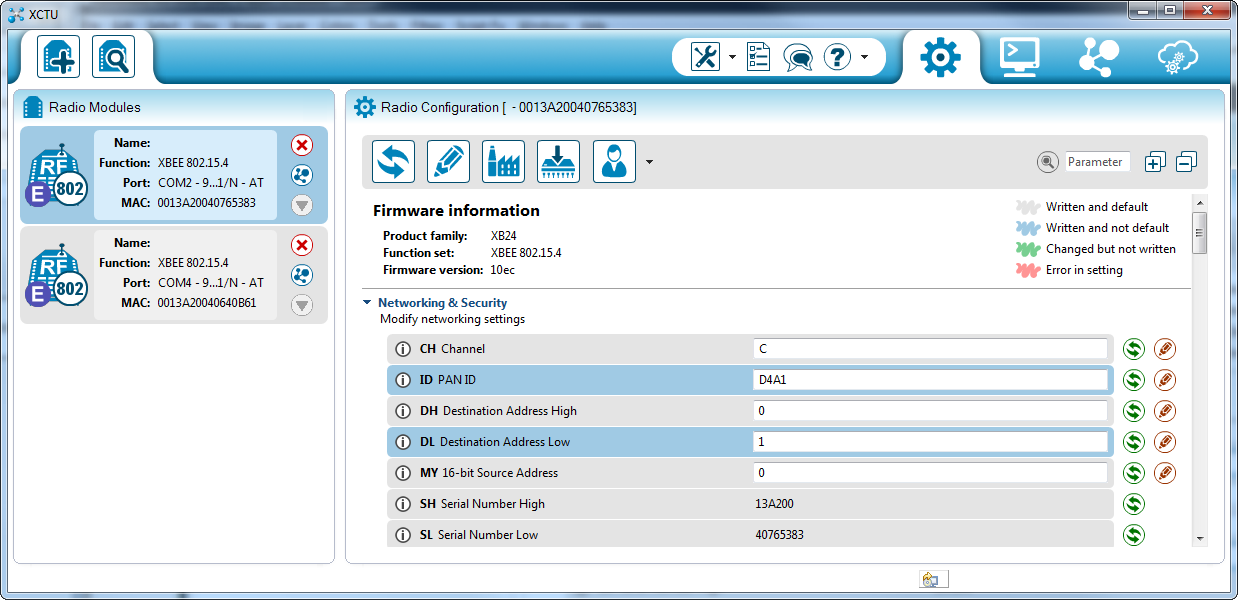
It now appears in the top panel, and you should be able to test/query the XBee sucessfully.
Xbee Software Download
Your very own selfmade Mac version of X-CTU and your XBee should now be able to play well together.Caveat: The com port number is forgotten by X-CTU on shutdown. So you have to go to 'User Com Ports'->'Add' every time you start up your X-CTU wrapper again.